
Decking in Oxted
Hillside gardens in Oxted suit ground screws: galvanised steel piles wound into the ground, with no concrete to mix and barrow up a slope. The town centre stands on free-draining sand while Hurst Green and Holland sit on Weald Clay, so we test the ground and check the 300mm planning line before choosing the footing.

Tandridge council, RH8, sand in town and clay to the south
- Planning
- Tandridge District Council
- Building control
- Southern Building Control Partnership (Tandridge's council building control)
- Highways and county
- Surrey County Council
- Postcodes
- RH8, RH9
- From our base in Crawley
- About 13 miles north-east


A garden deck on ground screws, built down a slope
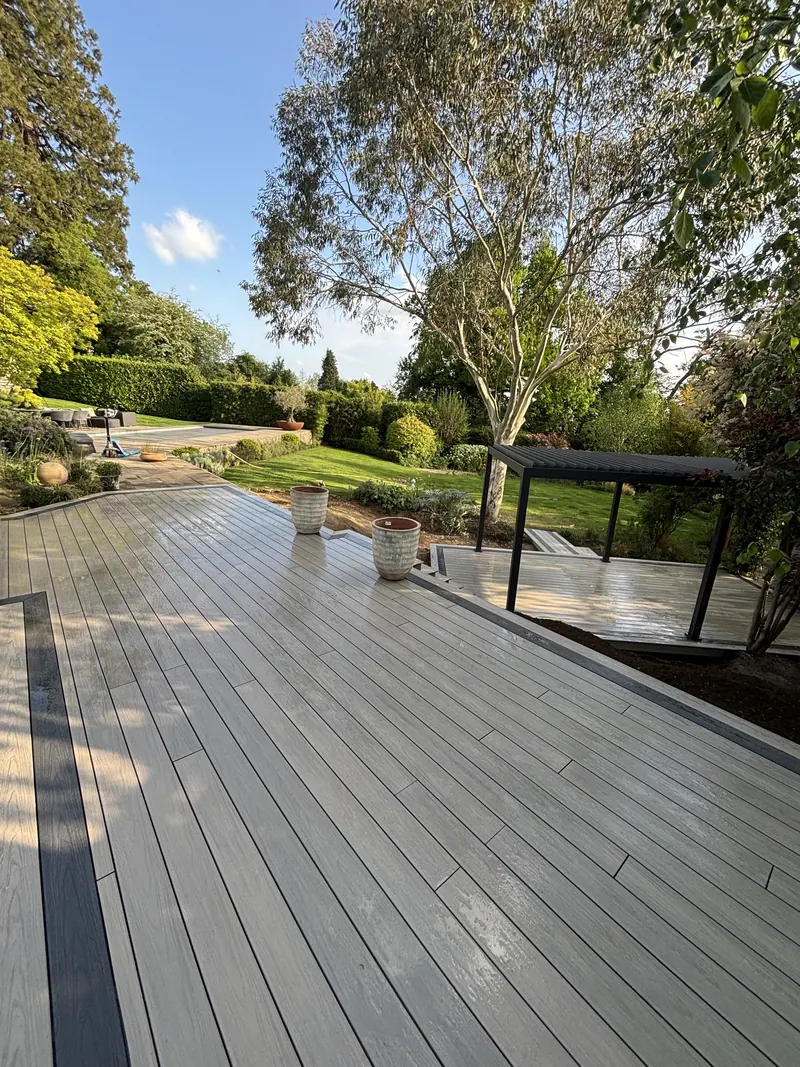
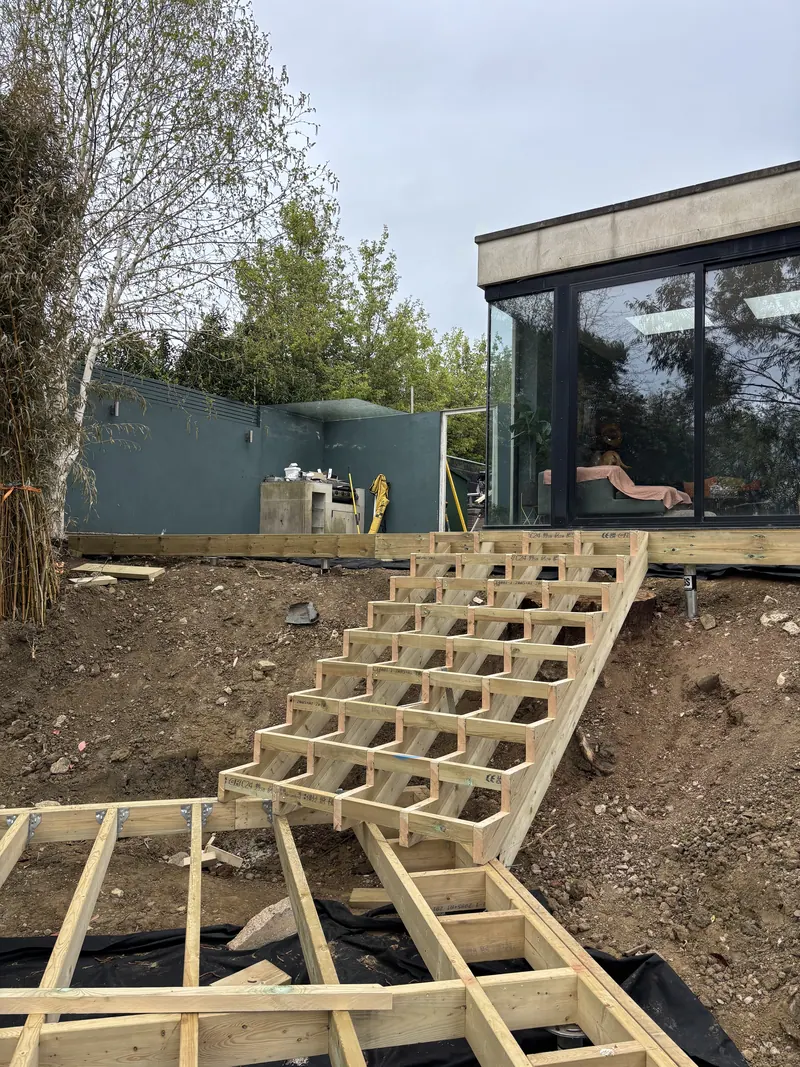
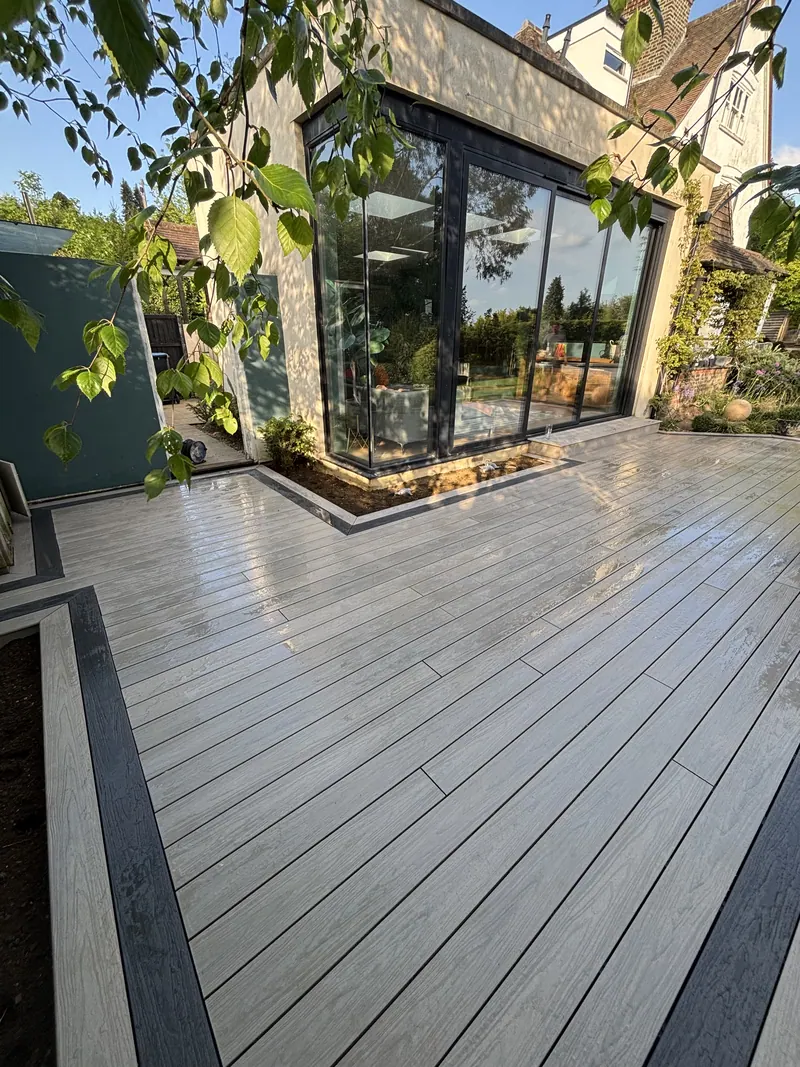
In April 2026 we built a large deck on two levels in a Surrey garden that falls away from a glazed extension. Galvanised ground screws went in first, set to level across the whole footprint, so nothing had to be dug out or left to cure. On top we built grids of C24 joists, every one wrapped in black joist tape, because a composite deck only lasts as long as the timber under it, and the tape keeps water off the joist tops and out of the screw holes. Steps climb the bank on cut stringers, and we backed each stringer with a length of 6x2 to give it more depth where the cuts are made. The boards are pale grey composite with a charcoal picture frame border, and the lower deck sits under a louvred aluminium pergola. On 1 May we posted the finished job with the words: "Deck officially decked. What a job."
- Where
- Surrey
- On site
- April to May 2026
- Our role
- Deck frames, steps and composite boards
- Work
- Decking on two levels, timber steps, ground screw base
Why ground screws make sense on a sloping Oxted plot
A ground screw is a galvanised steel pile wound into the earth by machine. On a garden that climbs or falls, that solves three problems at once. There is no digging out of pads, so the slope is not disturbed and there is little spoil to carry away. There is no wait for concrete to cure, so the frame can go on the same week. And the screws can be placed between tree roots, which matters in an established garden.
They are not always the answer. Where the ground is full of old rubble, or a screw meets something it cannot pass, concrete footings can still do the job better, and we say so after a trial at survey. On the Weald Clay at Hurst Green and Holland, proved by a 1958 borehole to run about 170m deep, a screw or footing has to reach below the layer that dries and swells.

Conservation areas, the Green Belt and the height rule
Three conservation areas in the town
Oxted (1972), Station Road West (1990) and Broadham Green and Spring Lane (1990), with Limpsfield Village alongside under its 2022 appraisal. Extra restrictions apply on designated land, so for a house in any of them we check with Tandridge before anything is planned.
Green Belt and permitted development
The town, Hurst Green and Limpsfield's built-up area are inset from the Green Belt, while Old Oxted is washed over by it. Green Belt status alone does not remove permitted development, so a deck within the normal limits is treated the same either way.
The 300mm line on a hillside
A deck becomes a raised platform, and needs planning permission, if any point sits more than 300mm above the ground beside it. On a slope that is usually decided by the downhill corner.
Water from the hills
The headwaters of the River Eden meet in Oxted, and winter 2013 to 2014 brought flooding to parts of Oxted and Limpsfield. On low plots we check the long-term flood risk for the address before setting the frame height.
Inside the ground screw deck, from frame to finish
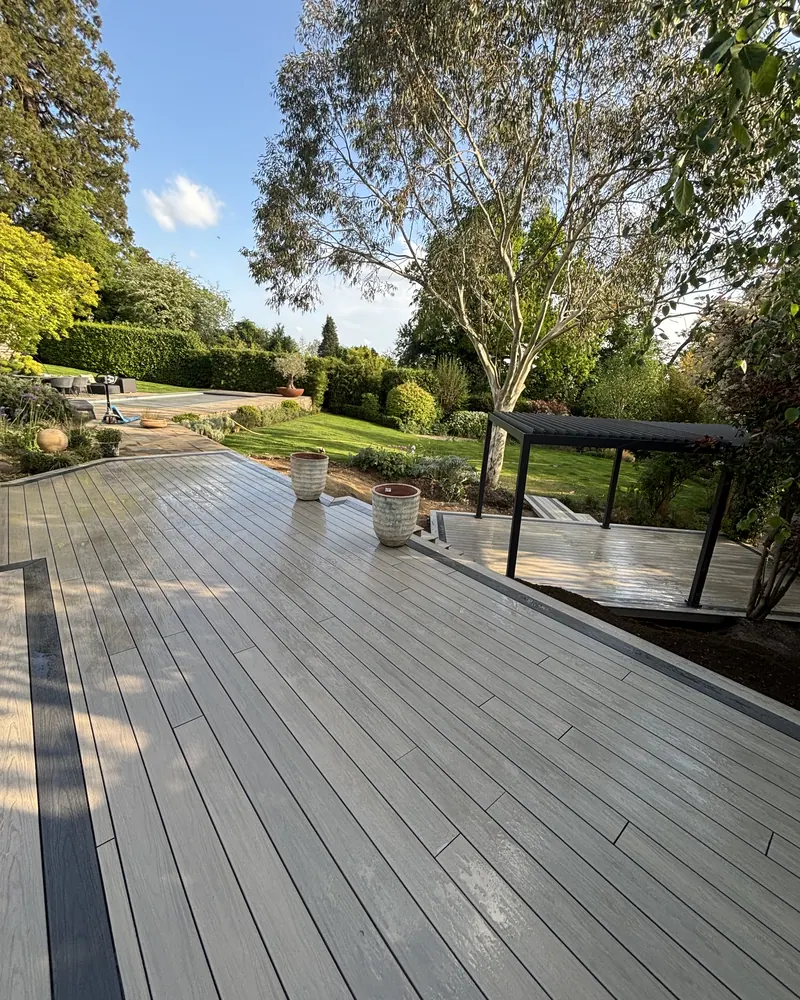
Upper deck stepping down to the pergola, May 2026 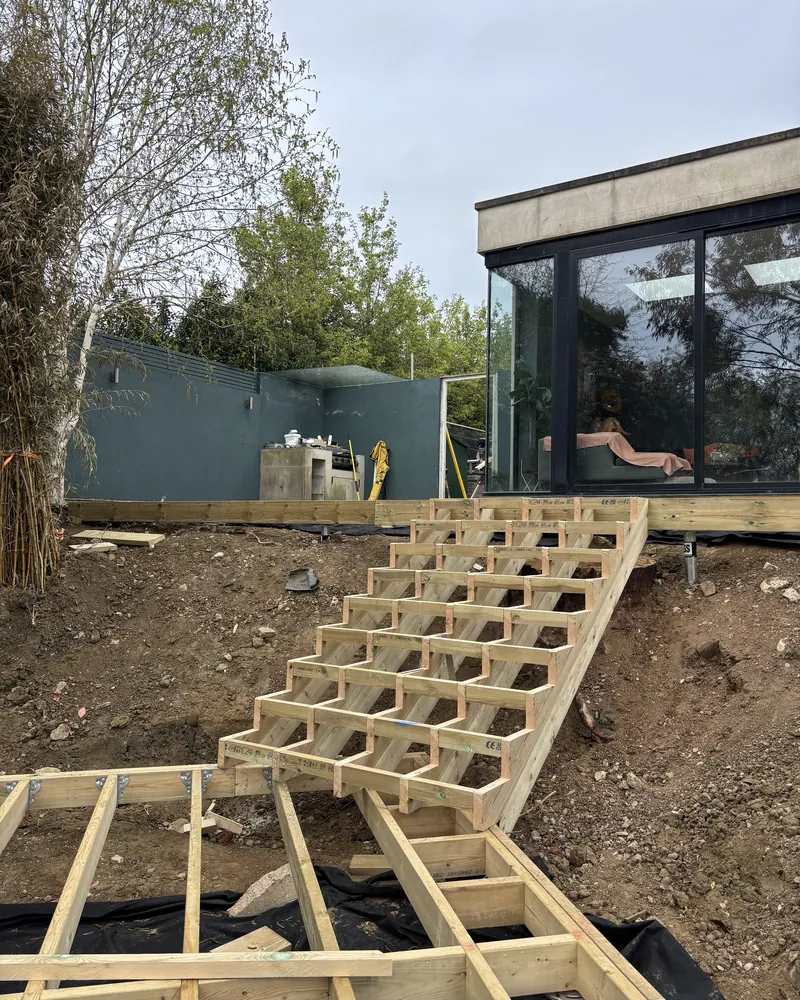
Stringer steps before the boards went on, April 2026 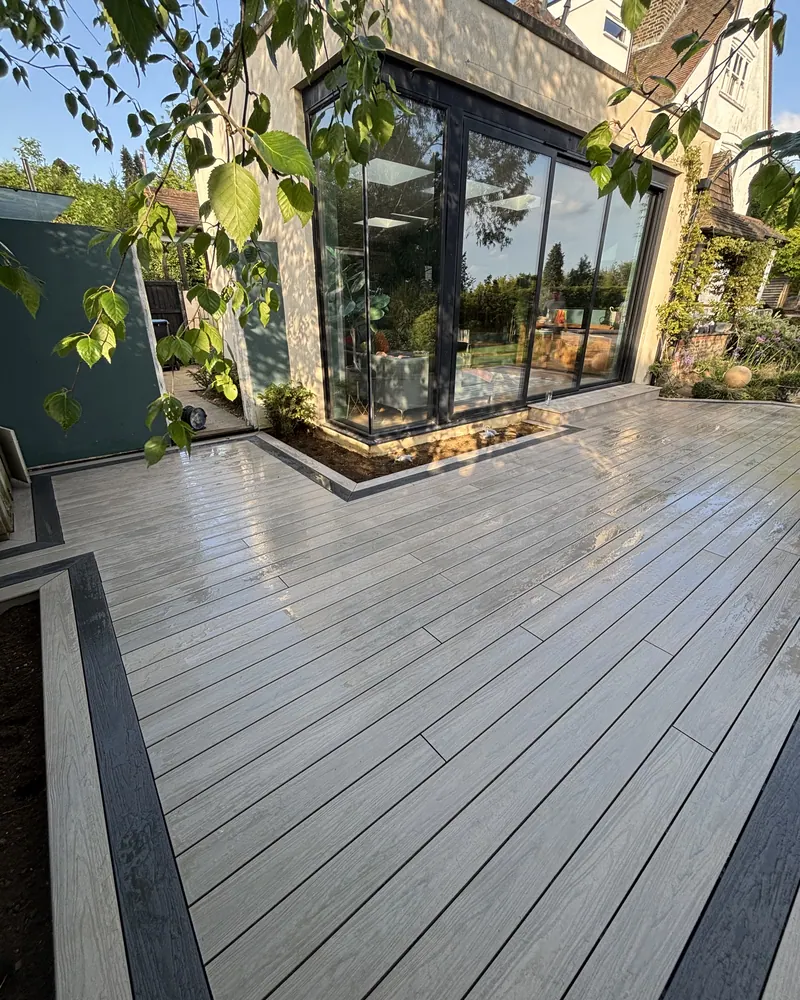
Picture frame border along the glazing, May 2026
Oxted questions about ground, Green Belt and screws
Something else? Call or WhatsApp 07494 000065.
Is the ground in Oxted chalk?
Not in the town. The centre and Limpsfield village sit on the Folkestone Beds, a sand and soft sandstone that drains well. South towards Hurst Green and Holland it turns to Weald Clay. The chalk is on the Downs north of the town, beyond the M25, so a garden deck in RH8 rarely reaches it.
We live in Old Oxted, which is in the Green Belt. Is a deck still allowed?
Usually. Green Belt status does not take away permitted development, so a low deck behind the house is treated as it would be anywhere else. Old Oxted also has a conservation area, though, and that does add restrictions. We check your address against both before drawing anything.
How do ground screws compare with concrete footings?
Screws go in quickly, need no digging or curing and leave the garden tidy, which suits slopes and gardens with roots or poor access. Concrete is still better on rubble-filled ground or where a screw cannot get down. We try the ground at survey and tell you which we would use and why.
Our garden in Hurst Green holds water. Does that change the deck?
Yes. Hurst Green is on Weald Clay, with river gravels in places where water sits close to the surface. We lay membrane on a free-draining base, keep timber well clear of the ground and take the supports below the clay that moves between summer and winter.
Our method, from first levels to final board
Every deck starts with a site visit. We take levels across the whole footprint, at the door threshold and at the damp proof course, and look at what the ground is made of. The written quote names the boards, the frame and what it all stands on. Posts and anything near the soil are Class 4 treated timber, composite goes on taped joists with stainless fixings, and the frame stays about 10mm off the wall. More on how we build decks.