
Fire door repairs for flats and shared buildings
Yes, we repair fire doors that have failed a check or been damaged: closers that don't shut the door, loose hinges, painted-over seals, gaps that have opened up, and frames split by a forced entry. Each repair follows the door's data sheet, and we tell you plainly when a door can't be saved.

- What we repair
- Closers, hinges, gaps, intumescent strips, smoke seals, frames and damaged leaves
- Who it's for
- Freeholders, managing agents, landlords and leaseholders with the building's agreement
- How we work
- To the doorset maker's data sheet, with photos of each door before and after
- Booking
- Planned work by email. A forced door that won't shut, ring 24/7
Why fire doors in shared buildings stop working
Fire doors rarely fail on their own. People make them fail, usually without meaning to. A closer that slams gets unhooked. A door that drags gets wedged open, and the hinges drop a little more every week it stands like that. Smoke seals get painted over by the decorators. A resident swaps the lock or adds a letterbox with whatever was in the shop. And every so often a flat front door gets forced, by a burglar, the police or a fire crew, and is screwed back together just enough to shut.
Since January 2023, blocks with a top storey more than 11 metres up have had to check their communal fire doors every three months and use best endeavours to check flat front doors every year. Those checks are finding faults, and the faults need fixing.
That's the work on this page: the repairs a check turns up, and the forced or damaged doors that can't wait for the next check. We work for freeholders, managing agents, landlords and residents' companies, and for leaseholders where the building has agreed the work. If your fire risk assessment or your contract asks for a third-party certificated installer, tell us at the start, so we can tell you straight whether we're the right firm.
The full background on the 2022 regulations and what a check looks at is in our guide to fire doors and the 2022 rules.
What do the 2022 fire door rules say about repairs?
The Fire Safety (England) Regulations 2022 set the checks. The Home Office guidance sets the expectation once a check finds something: repair or replacement by a competent contractor, as soon as reasonably practicable. It also says an old door isn't unfit just because it has no seals or certificate, which matters when someone's quoting for new doors.
| Rule | What it means for you | Source |
|---|---|---|
| In any building with two or more flats and common parts, residents must be told to keep fire doors shut, not to tamper with self-closers, and to report faults or damage straight away. | Residents reporting a fault is the system working. The report is the start of the repair. | Fire Safety (England) Regulations 2022, regulation 10 |
| Where the top storey is above 11 metres, communal fire doors must be checked at least every 3 months, and flat entrance doors checked on a best endeavours basis at least every 12 months. | Taller blocks get regular, recorded checks. The faults they find need somewhere to go. | GOV.UK fact sheet: fire doors (regulation 10) |
| Where checks find a fire door needs repair or replacement, the work must be done by a competent contractor as soon as reasonably practicable. | A failed check isn't something to park until the next budget round. | Home Office fire door guidance, paragraph 6.4 |
| Missing intumescent strips and smoke seals, and the lack of any certification, don't on their own mean a flat entrance door is unfit for purpose, provided it's undamaged and the gaps aren't too large. | Repair before you replace. A sound old door can often stay, with the fire risk assessment having the final say. | Home Office fire door guidance |
| A resident who wants to alter or change their front door should do it with the knowledge and agreement of the Responsible Person. | Leaseholders: agree any repair or new door with the freeholder or managing agent before booking us. | Home Office fire door guidance, paragraph 5.4 |
| Where needed for safety, the responsible person must make sure the premises and the fire safety facilities and devices are maintained in an efficient state, in efficient working order and in good repair. | Fire doors and their closers are part of that duty in every building the Fire Safety Order covers. | Regulatory Reform (Fire Safety) Order 2005, article 17 |
Who signs it off
- The Responsible Person, usually the freeholder, residents' company or managing agent, who arranges checks and repairs.
- The fire risk assessor, who decides whether a door is adequate for where it is.
- Our team, for the carpentry repair or replacement once that's decided.
Checked November 2026 against legislation.gov.uk and the Home Office fire door guidance on GOV.UK (updated 8 August 2025)
The fire door faults we repair
Before we change anything, we find the door's label or data sheet if there is one. The repair has to stay inside what the doorset was tested with.
Closers
Adjusted or replaced so the door closes fully into the frame from wide open and from about 15 degrees, and latches without slamming. A slamming closer is the one residents unhook.
Hinges
Loose screws refixed into sound timber, worn or missing hinges replaced with the type and number the data sheet names, so the door stops dropping.
Gaps
Doors that have dropped or a frame that has moved brought back so the gaps are right down both sides and across the head. We don't plane a fire door past its data sheet to make it fit.
Strips and seals
Intumescent strips and smoke seals that are painted over, torn or missing replaced like for like, and left free to work.
Forced flat front doors
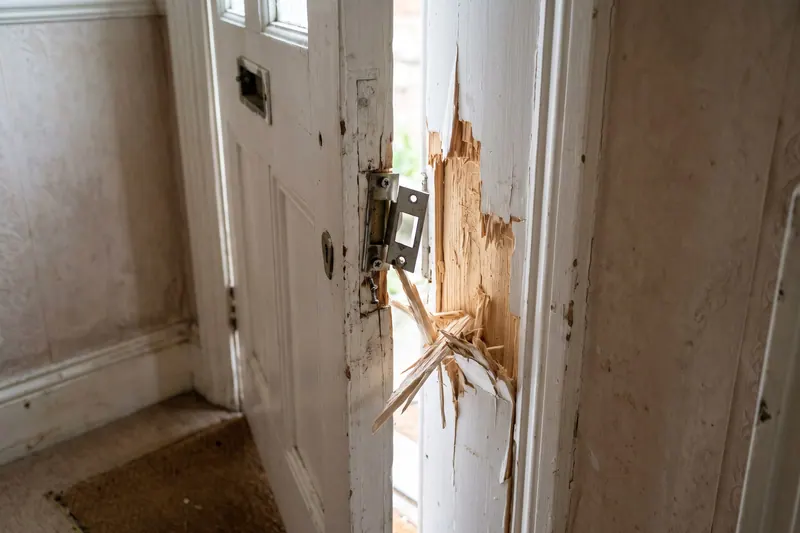
Frames and leaves damaged by a forced entry assessed against the maker's guidance. Some can be repaired. Many can't, and then a new doorset is the honest answer.
Holes and wrong parts
Old lock holes, cut-in letterboxes and spyholes looked at case by case. Only parts the doorset maker allows go back in.
Replacement doorsets
Where a door can't be saved, a new fire doorset hung to its data sheet, with the paperwork handed to the Responsible Person.
From a failed check to a closed-off fault
Send the check results
You
The check record or fire risk assessment action, photos of each door from both sides, and the label on the hinge edge if there is one.
Look at each door
Our team
Closers, hinges, gaps, seals, frame and leaf. Then a plain answer for each door: adjust, repair or replace.
A written quote, door by door
Our team
Each door listed with its faults and what we'd do, so you can approve some and leave others for the assessor.
Approval
You · Depends on your building's sign-off
The Responsible Person approves the work. Leaseholders get the building's agreement before any change to a flat front door.
Repairs
Our team
Booked around residents, with access to each flat arranged in advance. Doors are never left unable to close at the end of a day.
The record
Our team
Photos of each door before and after, and a note of what was done, for the building's fire safety records.
What to send us
- Where each door is: flat front door, stair door, lobby, corridor or riser cupboard.
- How many storeys the building has.
- The check record or fire risk assessment action that flagged the door.
- Photos of each door from both sides, closed and open.
- A photo of any label or plug on the hinge edge.
- Close photos of the closer, the hinges and the gap at the lock side.
- Who the Responsible Person is, and who signs off the work.
- How we get access to flats, and any times that don't work for residents.
Fire door repairs done wrong, and what we do instead
A fire door that looks repaired and one that will hold back smoke aren't always the same door.
- The shortcut
A forced flat front door screwed back together and left like that
What we do insteadSecured that night, then repaired or replaced as a fire door, with the Responsible Person told
- The shortcut
A sound old door replaced just because a check noted missing seals
What we do insteadThe door repaired where it's undamaged and the gaps are right, with the assessor deciding
- The shortcut
A split frame filled and painted so it passes a glance
What we do insteadJudged against the maker's guidance, and replaced where a repair can't be backed up
- The shortcut
Work done with nothing written down
What we do insteadPhotos and a note for every door, ready for the building's records
Send us the check results and a photo of each door from both sides. We'll tell you which can be repaired and which can't, door by door.
Get a quoteQuestions people ask about fire door repairs
Something else? Call or WhatsApp 07494 000065.
Can a fire door be repaired, or does it have to be replaced?
Often repaired. Closers, hinges, seals and gaps are all repairs, and the government guidance is clear that a sound older door isn't unfit just because it has no seals or certificate. A door with a split leaf, a big hole from an old lock, or a frame that's been smashed by a forced entry is usually a replacement. We'll say which, door by door.
How quickly does a fault have to be fixed?
The Home Office guidance says that where checks find a fire door needs repair or replacement, a competent contractor should do it as soon as reasonably practicable. There's no fixed number of days. A closer that doesn't shut a stair door is more pressing than a scuffed seal, so we'd usually start with whatever affects the escape route most.
My flat's front door was forced. What happens now?
If it won't shut, ring 07494 000065 at any hour and we'll secure it that night. Then tell the freeholder or managing agent, because a flat front door onto a shared hall is part of the building's fire safety. The proper repair, or a new fire doorset, should follow as soon as it can be agreed.
As a leaseholder, can I book the repair myself?
You can ask us, but agree it with the freeholder or managing agent first. The guidance says changes to a flat front door should be made with the Responsible Person's knowledge and agreement. Who pays depends on your lease and who owns the door, so check that before anything is booked.
Can I fit my own lock, letterbox or spyhole to a fire door?
Not just any one. A fire door is tested as a set, and a hole cut for an ordinary letterbox or a lock that wasn't in the test can stop it working as a fire door. Ask the Responsible Person first, then use only parts the doorset maker allows.
Does my house need fire doors?
The 2022 regulations apply to buildings with two or more flats sharing common parts, so a single family house isn't covered by them. Whether a particular house needs fire doors is a Building Regulations question, and our guide to fire doors goes through it.
Other door work in shared buildings


Read before your next fire door check

Fire doors flagged at the last check?
Send us the check results and photos of each door. We'll look at them door by door and tell you what's a repair, what's a replacement, and what can wait for the assessor.
Useful to send
- The check record or fire risk assessment action
- Photos of each door from both sides, and any hinge-edge label
- The building's address, storeys and who signs off the work