
Skirting and architrave in Dorking
We fit and match skirting in Dorking, where listed houses change the job. Its conservation area holds 120 listed buildings, and inside those, old boards count as part of the building, so replacing them can need Mole Valley's consent first. Rose Hill's Victorian villas and post-war Chart Downs want very different profiles again.

Dorking's town centre and its edges
- Planning
- Mole Valley District Council
- Building control
- Southern Building Control Partnership
- Highways and county
- Surrey County Council
- Postcodes
- RH4, RH5, RH3, KT20
- From our base in Crawley
- About 11 miles north-west
Listed buildings in the town centre
Trim is part of the listing
Under the Planning (Listed Buildings and Conservation Areas) Act 1990, anything fixed to a listed building is treated as part of it. Original skirting and architrave are covered in every room, not just the front ones.
Consent comes first
Work that affects a listed building's character needs listed building consent from Mole Valley District Council before it starts, and doing it without consent is a criminal offence. Ask before any original moulding comes off the wall.
Unlisted houses
Dorking's conservation area rules and Article 4 directions deal with outside changes. In a house that isn't listed, the trim inside is your choice.
Timber frames, Rose Hill villas and Chart Downs
The oldest buildings on the High Street are timber-framed, from the 15th to the 17th century, with the White Horse Hotel and 20 and 22 High Street, both Grade II*, among them. Georgian fronts follow along the High Street and South Street. The railway arrived in 1849 and Rose Hill was complete by 1861. Chart Downs went up between 1948 and 1952 and Goodwyns in the late 1950s and 1960s, and newer homes line Deepdene Avenue and Lincoln Road. About 31% of Dorking's homes were flats at the 2011 Census. Georgian and Victorian rooms usually had deep ogee or torus boards; the post-war estates something far plainer.
Taking old boards off a Georgian or Victorian wall
Paint on skirting in a house built before the 1980s may contain lead, so we don't dry sand it or burn it off, and any rubbing down is done wet, as the HSE advises. Old plaster above a board can be soft and come away with it, so we lift lengths slowly. Any sound original piece is kept, because it's the best pattern there is for a match.

Matching a skirting profile nobody makes now
How the fitting goes
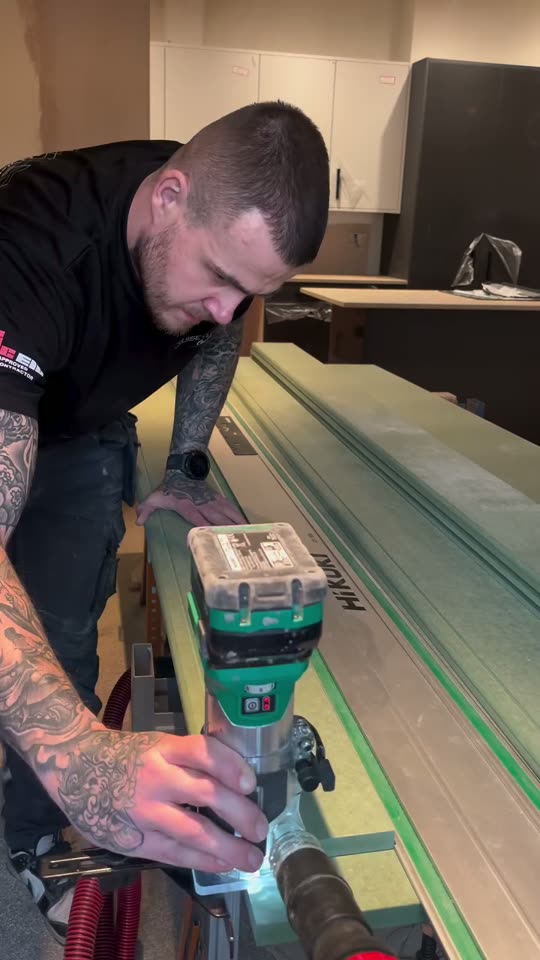
We measure every run and opening before the boards are ordered. On the day, internal corners are scribed and glued with PVA, external corners are mitred, and the excess glue is wiped off so the boards are ready for decorating. Architrave goes on with an even margin round the door lining, and where a floor steps we can run one stepped length instead of two short pieces. There's more on our skirting and architrave page.

Skirting and architrave in Dorking: your questions
Something else? Call or WhatsApp 07494 000065.
Our cottage on the High Street is listed. Can you replace one damaged length of skirting?
Probably, but ask Mole Valley first. The skirting is part of the listing, and the council decides whether a repair affects the building's character. We can make a sample length to the old profile so the conservation officer has something specific to look at, and the original stays on the wall until you have an answer.
We're on Chart Downs. What skirting suits a house built in the late 1940s?
Something plain. Chart Downs was built between 1948 and 1952, when trim was far simpler than in Rose Hill's villas. A modest rounded or chamfered board that suits the doors usually looks right, though if an original survives in a cupboard, we'd copy that instead.
We've bought a newer flat off Deepdene Avenue. Can you change the developer's skirting for something taller?
Yes. A taller board changes how a room looks with very little disruption, as long as sockets and radiator pipes are planned around. Check your lease before booking, because some need the freeholder's consent for alterations, even inside the flat.
The architrave round our South Street doors has a moulding we can't find anywhere. Can you copy it?
Usually. We'd take a section from a door that's staying, or from a hidden offcut, and either find the nearest stock moulding or make one to match. Architrave on a listed house comes under the same consent question as the skirting, so check that first.