
Water-damaged floors, skirting and doors repaired
Yes, we repair joinery after a leak or a flood, though rarely on the same day, because swollen floors, skirting and door linings have to dry before anything is cut out or refitted. We'll come and look, photograph it for your insurer and tell you what can be saved, then come back once the moisture readings are down.

- Drying first
- Nothing refitted until the floor, walls and timber read dry on a meter
- What we repair
- Floors, joists, skirting, architrave, door linings, doors, kitchen plinths and stair treads
- For your insurer
- Photos before and after, and a quote itemised room by room
- Still pouring in?
- A ceiling bulging with water is an emergency: call 07494 000065
Why water-damaged joinery has to wait
Water finds its way everywhere after a burst pipe, a split washing machine hose or a leak from the flat upstairs. Chipboard floor panels swell at the edges and stay swollen. MDF skirting and kitchen plinths drink it up from the bottom edge and blow. Door linings stand on the floor and wick it up, so a door that closed fine last week now catches. Solid timber is more forgiving. It cups and lifts while it's wet, and a lot of it settles back as it dries.
That's why the first visit is mostly looking and measuring. Fit new skirting to a wet wall, or lay a new floor over a damp subfloor, and you pay for it twice. The new boards swell, the joints open, and mould gets going behind the skirting where nobody sees it until the smell arrives.
So the order is always the same. Stop the water, dry the building, then repair. If your insurer has sent a drying company, we work to their readings. If not, we'll tell you how to get it drying and come back with a moisture meter before we cut anything.
What we repair after a leak or a flood
Most of it is second fix carpentry, done in the right order once the room is dry.
Floorboards and chipboard floors
Swollen chipboard panels cut out between the joists and replaced. Cupped solid boards left to settle, then refixed, or swapped where they've split.
Joists and noggins
Checked under the worst of it. Softwood joists that got wet usually dry out sound. Soft or rotten ones from an old, slow leak are sistered or replaced.
Skirting and architrave
Blown MDF taken off and new lengths fitted, mitred and scribed to the profile used elsewhere. More on our skirting and architrave page.
Door linings and doors
Linings swollen at the foot spliced or replaced, and doors eased, trimmed or rehung so they shut properly again.
Kitchen plinths and end panels
Usually the first thing to blow. We replace them, and tell you straight if the chipboard carcasses behind are past saving too.
Stair treads and strings
Where water ran down the stairs, the bottom treads and the string can swell. Repaired in place or replaced tread by tread.
From the leak to a finished room
Water off, cause fixed
You
Stopcock off, plumber or roofer in. If it came from above, tell the neighbour or the managing agent straight away.
Claim opened
Your insurer
Tell them early, before anything is thrown out. They may want their own surveyor or drying company to see it first.
First look
Our team
Photos of the damage, moisture readings, and a list of what can be saved and what can't. Then an itemised quote.
Drying out
You · Days for a small leak, weeks after a flood
Heating on, a window open a crack, dehumidifiers running if you have them, and swollen boards lifted so air gets underneath.
Repairs
Our team
Once the readings are down: subfloor first, then floor, linings, doors, skirting and plinths, in that order.
Decorating
You
New MDF and timber need priming and painting, by your decorator or whoever your insurer appoints.
What to do while it dries out
- Turn the water off at the stopcock and find where it came from before anything else.
- Keep away from sockets and switches that got wet, and have an electrician check them before you use them.
- Photograph everything before you move it: floor, skirting, the bottom of the doors and the kitchen plinths.
- Keep a damaged offcut or a spare plinth, in case your insurer wants to see it.
- Pull the kitchen plinths off so air can get under the units. Most just clip on.
- Lift rugs and wet carpet so the floor underneath can dry.
- Run the heating and open a window a crack, so the damp air has somewhere to go.
- Don't refit, fill or paint anything yet, however tempting.
Putting the floor back once it's dry
When the readings are back to normal, we start at the bottom. Joists checked, soft ones sistered, and noggins added where cut-out chipboard needs its edges supported. New panels go down glued and screwed, so they don't squeak. Then the finished floor, with an expansion gap at the walls for the skirting to cover.
A floor repair after a leak takes the same care as a new one: a level base, the right underlay and boards that have had time in the room before they're fitted. Our flooring page covers the floors we lay.

Water damage shortcuts we won't take
- The shortcut
New skirting nailed onto a wall that's still wet
What we do insteadWall and floor checked with a meter first, then fitted
- The shortcut
New laminate laid over swollen chipboard
What we do insteadSwollen panels cut out and replaced, so the new floor sits on a flat, dry base
- The shortcut
A swollen door lining planed back so the door shuts for now
What we do insteadLining spliced or replaced once it's dry, so the gap stays right after it settles
- The shortcut
Only the visible plinth replaced while the carcass behind is soaked
What we do insteadUnits checked behind the plinth, and you're told if a carcass has blown
- The shortcut
Rotten joist ends from a slow leak boarded over
What we do insteadSoft joists sistered or replaced, and the leak traced first
- The shortcut
Mould behind the skirting painted over
What we do insteadSkirting off, the wall cleaned and dried, then new skirting fitted
Send photos of the floor, the skirting and the bottom of the doors, with what leaked and when. We'll tell you what can be saved before you replace anything.
Get a quoteQuestions people ask after a leak or a flood
Something else? Call or WhatsApp 07494 000065.
Can you come today?
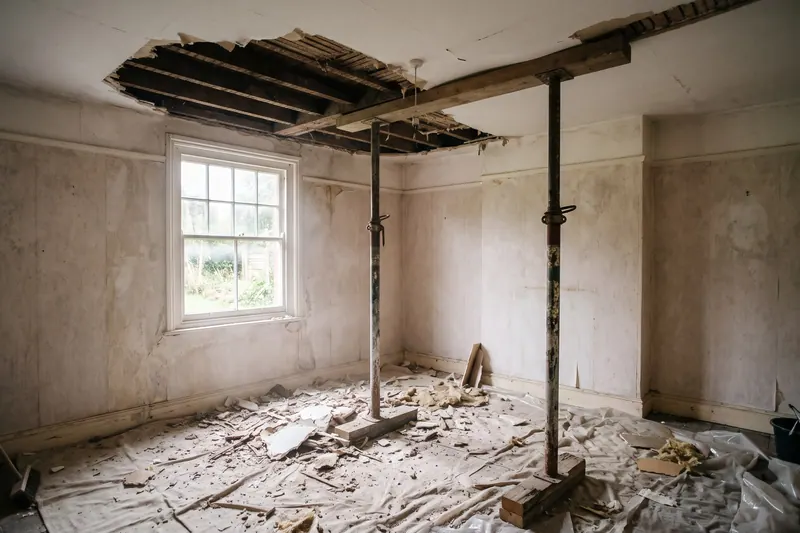
If water is coming through a ceiling, or a floor feels soft or bouncy underfoot, treat it as an emergency and ring 07494 000065. We answer around the clock and can prop a sagging ceiling or cover a hole. The joinery repair itself is better done once the room has dried, so that part gets booked in, not rushed.
How long does it take to dry out?
It depends how much water there was, how long it sat and what the floor is made of. A small leak onto a suspended timber floor can be dry in days with the heating on. A flood across a solid floor or a chipboard deck can take weeks, even with commercial dryers. We go by the readings, not the calendar.
Will my insurance cover it?
Damage from an escape of water is often covered on home insurance, but check your policy for the excess and any exclusions, and tell your insurer before you rip anything out. They may want their own people in first. We give you photos and an itemised quote, which is what insurers ask for.
Can you match my skirting and architrave?
Usually. Common profiles such as torus and ogee are still made in MDF and pine. An older or unusual profile can often be matched by having a length machined to a sample, which takes longer. If only one wall is damaged, we take a short offcut from it so the new length lines up exactly.
Can swollen chipboard flooring dry back out?
Not really. Once chipboard has swollen at the edges it stays that way when it dries, and it's weaker where the water got in. Panels that were only damp and are still flat can sometimes stay. The swollen ones get cut out between the joists and replaced with new moisture-resistant boards.
Does the whole floor have to come up?
Not always. A floating floor can sometimes be lifted, dried and relaid if the boards themselves haven't swollen. Glued or nailed floors are harder to save. And if a floor runs through a doorway into the next room, a patch can be hard to hide, so we'll be honest about whether a part replacement will look right.
The leak came from the flat above. Who pays?
That depends on what caused it, whose pipe it was and what your lease says, so start with your own insurer and, in a block of flats, the managing agent or freeholder. We can't settle who pays. What we can do is give everyone the same photos and the same itemised quote.
Other work that follows a leak


Worth reading before you get quotes

Had a leak and not sure what's ruined?
Send photos of the damage and tell us what leaked, when, and whether it's been fixed. We'll come and take readings, tell you what will dry out and what needs replacing, and give you an itemised quote your insurer can read line by line.
Useful to send
- Photos of the floor, skirting, door bottoms and plinths
- What leaked, when, and whether it's fixed now
- Your claim reference, if you have one