

Is the business real, and who's behind it?
Start with the name on the quote. A limited company is listed on Companies House, and searching it is free. Type the name in and check four things: the status says active, the incorporation date fits the story you've been told, the directors are the people you're dealing with, and there's no warning about overdue accounts.
A company has to show its registered number and registered office on its letters, order forms and website (the 2015 trading disclosure rules). If a quote from a firm calling itself Ltd has no company number on it, ask why. Then check the number matches the name. Plenty of firms have similar names, ours included.
Sole traders and partnerships aren't on the register, and that's fine. Lots of good tradespeople work that way. Get a full name and a postal address, not just a mobile number. If they charge VAT, the VAT number should be on the quote, and you can check it with HMRC's VAT number checker.
Do the reviews lead anywhere?
A review is only worth something if you can see where it came from. Reviews on Google or Facebook sit on the platform with the reviewer's profile and a date. A row of five-star quotes on a builder's own website, with first names and no links, could have been written by anyone.
Fake reviews have been banned outright in the UK since 6 April 2025. The Digital Markets, Competition and Consumers Act 2024 bans writing them, paying for them, and hiding the bad ones while showing off the good. That doesn't stop it happening, so read reviews like a sceptic:
- Are the dates spread over months and years, or bunched into one week?
- Do they describe a real job, with the kind of detail only the customer would know?
- How does the builder answer the bad ones? A calm reply to a complaint tells you more than ten perfect scores.
- Will they put you in touch with a recent customer, with that customer's agreement?
A small firm with a handful of genuine reviews is a better bet than a big number you can't trace. Most local builders don't have hundreds, and that's normal.
Can you see their own work, not just the finished photo?
Ask to see jobs they've done, and ask what their part was. A lot of building work is shared between firms, so a photo of a finished extension might show the builder's work, the roofer's or the landscaper's. An honest trader tells you which bits were theirs. On our jobs we say up front who does what, and our process page sets out how a job runs from the first visit to handover.
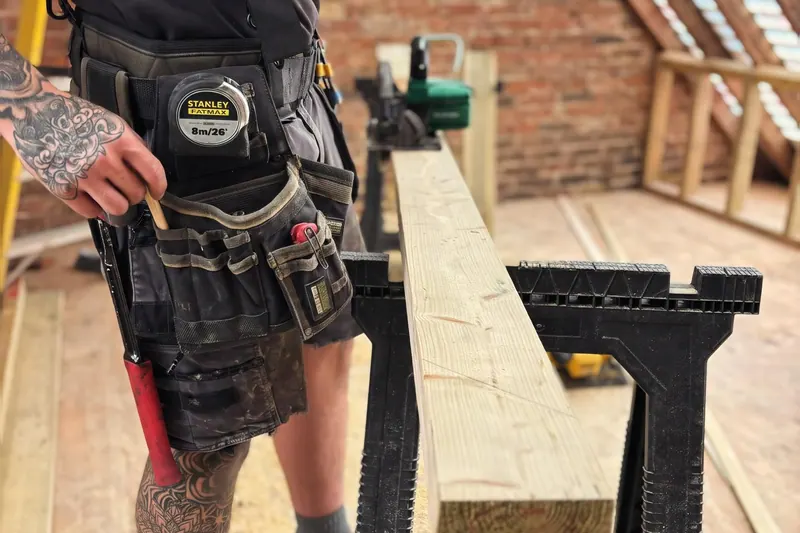
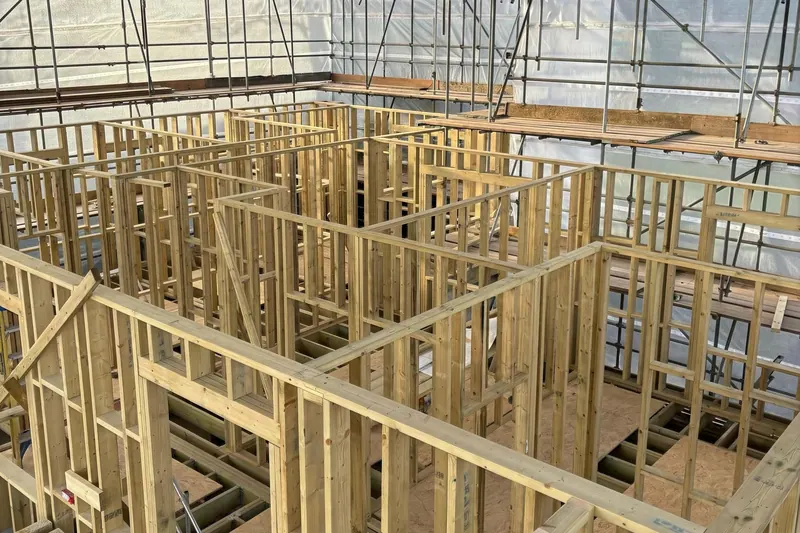
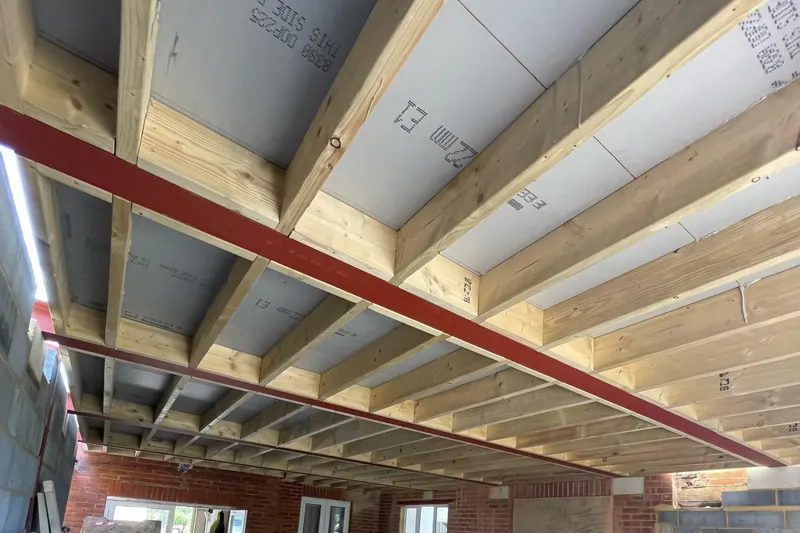
The best evidence is work in progress. Anyone can photograph a finished kitchen. Photos and videos of the frame, the joists, the membrane and the insulation going in show you how a firm builds the parts you'll never see again. Check the dates, and look for real places, real weather and the same faces turning up job after job.
Be wary of pictures that look too perfect. Stock photos and AI images give themselves away with odd lighting, garbled lettering and strange hands. If you can, see a finished job in person or speak to the customer. A happy customer rarely minds a short phone call.

Ask for the insurance certificate, not a promise
A line on a van saying a builder is insured proves nothing. Ask for a copy of the certificate and read three things on it: the name matches the business you're hiring, the dates cover your job, and the policy covers the type of work you're having done.
Public liability insurance covers damage to your property and injury to other people. Builders aren't required by law to hold it, which is exactly why it's worth asking. Employers' liability insurance is different. Any business that employs staff must have it, with narrow exceptions such as employing only close family (GOV.UK). If a builder brings a team, ask to see that certificate too.
A good builder sends these without a fuss. If the certificate keeps not turning up, take note.
Who's doing the gas, the electrics and the Building Regulations?
Since October 2023 the law requires everyone designing or building your project to be competent for the work they take on, and to make sure it complies (Building Regulations Part 2A). Some parts of a job can only be signed off by people registered to do them, so check those people by name, not on the main builder's word.
- Gas. Anyone working on gas appliances or pipework must be on the Gas Safe Register. Ask for the engineer's name and look them up.
- Electrics. New circuits and replacement consumer units are notifiable. An electrician registered with a competent person scheme can certify their own work, and you can find them on the electrical competent person register.
- Building Regulations. Most extensions, loft conversions and structural alterations need Building Regulations approval, even when they don't need planning permission. Ask who will apply, before work starts, and which building control body it is. Private building control firms must be on the Building Safety Regulator's register.
At the end you should be handed the completion certificate from building control and the electrical and gas certificates. Keep them with the house paperwork. You'll need them when you sell. If you're not sure whether your job needs approval at all, our guide to planning permission and Building Regulations explains the difference.
Get a written quote, not a figure on the doorstep
A quote is a fixed price for a described job. An estimate is a guess that can move. Citizens Advice suggests getting written quotes from at least three traders, and warns that a price far below the rest can mean the work isn't the same or the trader isn't being upfront. A proper written quote lists:
- the work, item by item, and what's left out
- the materials, by type or brand where it matters
- the total, with VAT shown
- how long the price holds and what could change it
- the payment stages
- a likely start date and how long the job should take
- who applies for building control and any other approvals
What a builder tells you counts too. Under the Consumer Rights Act 2015, things a trader says or writes about the work can become part of the contract if you rely on them, so get the important promises written down. Our guide to comparing builders' quotes goes through a quote line by line, and how we quote shows what goes on ours.
Paying a builder, and your right to cancel
Pay for work as it's done, in stages written into the quote. Some builders ask for a deposit against materials ordered specially for your job; ask what it covers and when they'll be delivered. Paying most of the price before anything has happened on site is a risk you don't need to take. If you can, pay part of it by credit card. Section 75 of the Consumer Credit Act 1974 can make the card company jointly liable if the work goes wrong, within the limits the law sets.
If you agree the job at your home, or online or over the phone, the Consumer Contracts Regulations 2013 usually give you 14 days to cancel. They don't cover building a new house, but they do cover most home improvement work. The builder has to tell you about that right. If they don't, the cancellation period can run on for up to 12 months.
They also can't start inside those 14 days unless you ask them to, and for a contract signed at your home that request has to be on paper or by email. If you then cancel, you pay a fair share for the work done up to that point, not the whole price.
Warning signs worth walking away from
One of these on its own doesn't make a builder a cowboy. Two or three together usually means it's time to say thanks and look elsewhere.
- They knocked on your door or rang out of the blue to say your roof or drive needs work.
- The price is only good if you sign today.
- They want most of the money before they start.
- Cash only, and nothing in writing.
- No full name, no address, just a mobile number.
- They say you won't need planning or Building Regulations without asking a single question about the job.
- They can't show you a job of theirs part way through.
- The insurance certificate never arrives.
A builder worth hiring is usually booked a while ahead and doesn't need to rush you. If you feel pushed, that's the answer.
How to check us
Do all of the above to us. Here's where to look.
- The company. Lewis Brothers Carpentry & Construction Limited, company number 17379324, is on Companies House. The limited company was registered in August 2026. The registered office is our accountant's address in Haywards Heath. We work from Crawley.
- The work. Our Instagram, @lewisbrotherscarpentry, shows our jobs being built stage by stage, frames and joists included, with a date on every post. Where a job was for or with another firm, we say so.
- The award. Our carpentry won Tradesperson of the Year and Carpenter of the Year at the On The Tools Awards 2024. Our awards page has the details and where they were published.
- Reviews. We only show reviews you can trace back to where they were posted.
For anything else on this page, ask us. Call 07494 000065 or email sales@lewisbrotherscarpentry.co.uk, and judge us on how quickly and plainly we answer. When you're ready to talk about your own job, our process page shows what happens from the first photos to the day we hand over.

Read next


Sources
- Companies House: find and update company information (GOV.UK), checked 12 November 2026
- Company, Limited Liability Partnership and Business (Names and Trading Disclosures) Regulations 2015, regulation 25 (legislation.gov.uk), checked 12 November 2026
- HMRC: check a UK VAT number (GOV.UK), checked 12 November 2026
- Digital Markets, Competition and Consumers Act 2024, Schedule 20 paragraph 13: fake reviews (legislation.gov.uk), checked 12 November 2026
- GOV.UK: employers' liability insurance, checked 12 November 2026
- Building Regulations 2010, Part 2A: dutyholders and competence (legislation.gov.uk), checked 12 November 2026
- GOV.UK: building regulations approval, checked 12 November 2026
- GOV.UK: find a registered building control approver in England, checked 12 November 2026
- GOV.UK: competent person schemes, current schemes, checked 12 November 2026
- Gas Safety (Installation and Use) Regulations 1998, regulation 3 (legislation.gov.uk), checked 12 November 2026
- Citizens Advice: before you get work done on your home, checked 12 November 2026
- Consumer Rights Act 2015, section 50 (legislation.gov.uk), checked 12 November 2026
- Consumer Contracts (Information, Cancellation and Additional Charges) Regulations 2013, regulations 6, 31 and 36 (legislation.gov.uk), checked 12 November 2026
- Consumer Credit Act 1974, section 75 (legislation.gov.uk), checked 12 November 2026