
Boarding up after a fire, day or night
Yes. Once the fire service has said the building is safe to approach, ring 07494 000065 at any hour and we'll tell you honestly when we can be there. We board broken windows and doors, sheet holes in the roof and photograph it all for your insurer, so the building stays shut and dry until repairs start.

- When we answer
- 24 hours, 7 days, including nights and bank holidays
- What we secure
- Windows, doors, holes in the roof and ceilings that need holding up
- Structure
- A structural engineer looks first before we prop anything that carries load
- For your claim
- Photos before and after, and an itemised invoice for the loss adjuster
What a building needs once the fire engines have gone
The fire is out, the crews have packed up, and the house is still open. Heat cracks glass, and windows are often broken to let the smoke out. Doors get forced to reach the fire. If it got into the roof, there may be a hole where the tiles and battens were. And everything below is wet, because putting a fire out takes a lot of water.
When the crews leave, nobody else is coming to shut it up. That's down to you, your insurer, or someone like us. It matters for two reasons. Rain gets in through every open window and hole in the roof, and the water damage can end up worse than the fire. And a burnt-out house with its windows open draws people in. West Sussex Fire and Rescue's arson advice is to keep property secure, derelict buildings included, and to fix damage quickly.
We board the openings, fit a temporary door where the front door is gone, and sheet the roof. Inside, we look at ceilings and floors that have taken water or fire, and where one is sagging or charred we keep everyone out of that room until an engineer has seen it.
Don't go back in until the fire service tells you it's safe. And leave the electrics and gas alone. Those wait for the people qualified to test them.
What we secure after a fire
Everything is fixed to sound material. Charred timber and wet plaster won't hold a screw, so we fix past them.
Windows
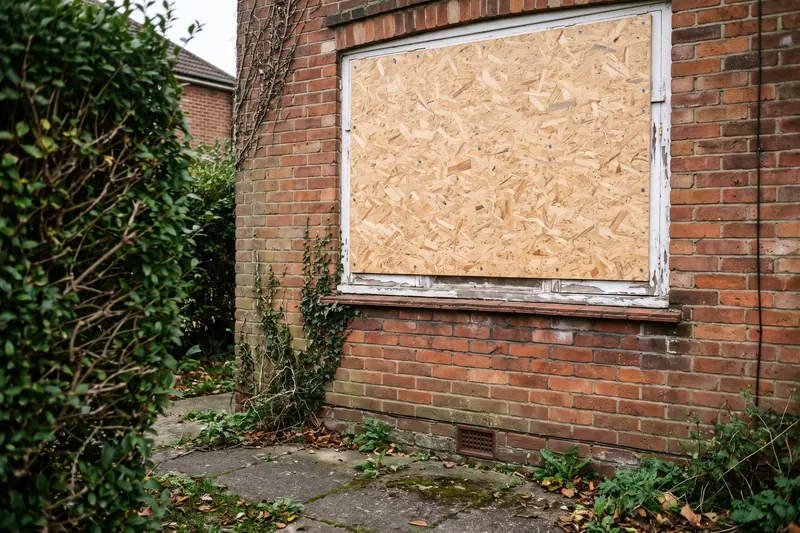
18mm ply or OSB cut to the opening and fixed to battens or the brick reveal, not into a burnt frame. Loose glass comes out first so nobody gets cut later.
Doors
A forced or burnt door replaced with a ply door that opens and locks, with a hasp and padlock. Our page on temporary secure doors covers how it's built.
Holes in the roof
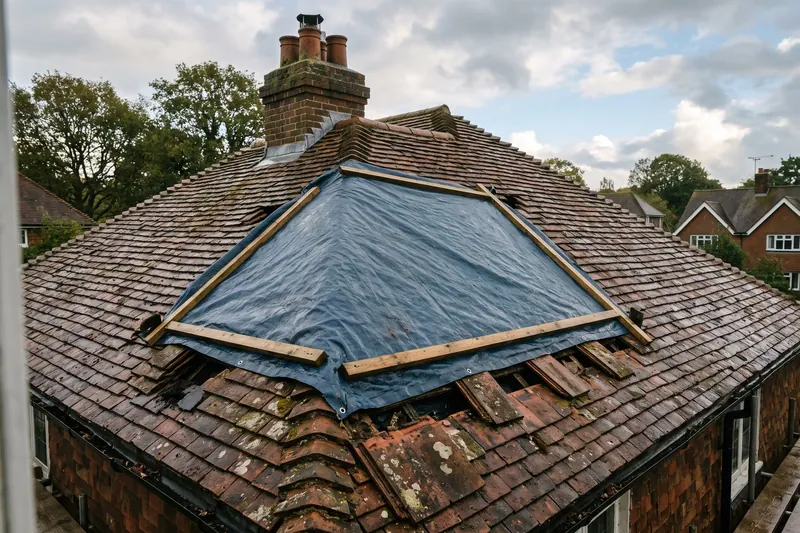
Tarpaulin battened down over the damaged area, or ply over a burnt-through section, so the rain stays out while the roof is assessed.
Ceilings and floors
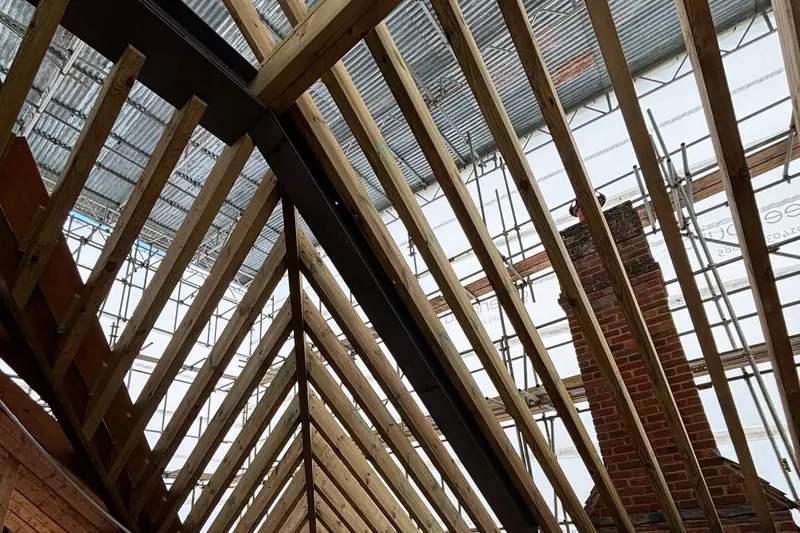
Rooms with sagging or charred ceilings closed off. Where something needs holding up, props on sole plates, after an engineer has looked.
The front of the building
If a wall or a shopfront is unsafe to walk past, timber hoarding or fencing to keep the public back.
The record
Photos of every opening and room before we start and after we finish, and an itemised invoice that lists each board, prop and sheet.
Before we get there
Nothing here is worth going back inside for. If you can't see it from outside, tell us what you remember.
- Stay out until the fire service tells you the building is safe to enter.
- Tell us whether the electricity and gas have been turned off, and by whom.
- Which windows and doors are broken, and on which floors.
- Whether the roof is open or the fire got into the loft.
- Any ceilings that are sagging, bulging or dripping.
- Whether anyone will be living there tonight, or the building will be empty.
- Whether it's attached to a neighbour's house or shop.
- Your insurer's name and claim number, if you've already rung them.
From the fire to the first repairs
Wait for the all clear
You
Stay out until the fire service says the building is safe. Ring your insurer's emergency line if you can.
Ring us
You
Call or WhatsApp 07494 000065 at any hour. We tell you honestly when we can get there and what we'll bring.
Photograph and secure
Our team
Photos first. Then windows and doors boarded, the roof sheeted, and dangerous rooms closed off.
Check the structure
Your engineer
Where floors, ceilings, walls or roof timbers have burnt or soaked through, a structural engineer says what needs propping or taking down.
Assess the claim
Your insurer · Insurers set their own timescales
A loss adjuster usually visits. Our photos and invoice show what was there and what we did.
The carpentry repairs
Our team
Roof timbers, floors, ceilings, doors and frames rebuilt, with Building Control where the work is structural.
What do the fire service and insurers say to do after a fire?
Stay out until it's safe, then stop it getting worse. The fire service's advice is not to go back into a burning building. The ABI says to arrange temporary repairs where needed, call your insurer first if you can, keep receipts, and not throw damaged things away too soon. And a dangerous building can bring the council in.
| Rule | What it means for you | Source |
|---|---|---|
| Surrey Fire and Rescue tells people to find somewhere safe to wait near the building, and not to go back in. | Wait outside until the fire service hands the building back to you. We don't go in before then either. | Surrey Fire and Rescue: what to do if fire breaks out |
| The ABI advises arranging temporary repairs if necessary to stop damage getting worse, calling your insurer's emergency helpline first if you can, and keeping the receipts. | Boarding and sheeting are the temporary repairs. Our itemised invoice is the receipt. | Association of British Insurers: home insurance |
| The ABI also says not to rush to throw damaged items away unless they're a health hazard, as your insurer may want to inspect them, and to photograph anything you do have to remove. | Anything we take out is photographed first, and kept for the insurer to see unless it is a hazard. | Association of British Insurers: home insurance |
| West Sussex Fire and Rescue's arson advice is that one of the best ways to prevent arson is making sure property is secure, including derelict buildings, and fixing damage quickly. | An empty, fire-damaged house is boarded the same visit, not left open for a week. | West Sussex Fire and Rescue: arson fires |
| If a building or part of one is dangerous and needs immediate action, the council can take the steps needed to remove the danger, giving the owner notice where practicable, and recover its reasonable costs. | Making a fire-damaged front safe yourself is usually quicker and cheaper than the council doing it for you. | Building Act 1984, section 78 |
Who signs it off
- The fire service, which decides when the building is safe to go back into.
- Your insurer and its loss adjuster, for the claim.
- A structural engineer, before anything that carries load is propped or removed.
- Electricians and gas engineers, before any supply goes back on.
Checked November 2026 against Surrey Fire and Rescue, West Sussex Fire and Rescue, the ABI and legislation.gov.uk
Fire board-ups done badly, and what we do instead
After a fire, everyone wants the place shut quickly. Quick is fine. Careless costs you later.
- The shortcut
Boards screwed into a charred window frame or wet plaster
What we do insteadBoards fixed to battens or the brick reveal, past the damage, where they'll hold
- The shortcut
Every window boarded but the hole in the roof left open
What we do insteadThe roof sheeted the same visit, because that's where most of the rain gets in
- The shortcut
A sagging ceiling propped off wet floorboards
What we do insteadThe room closed off, an engineer consulted, and props on sole plates down to something solid
- The shortcut
Burnt doors and frames thrown in a skip before anyone's seen them
What we do insteadPhotographed and kept until your insurer says they can go
- The shortcut
A single line on the invoice saying 'board up'
What we do insteadEach opening, sheet and prop listed, with photos before and after
Fire out and the house still open? Ring or WhatsApp 07494 000065 at any hour, once the fire service has given the all clear.
Call 07494 000065, 24/7Questions people ask after a fire
Something else? Call or WhatsApp 07494 000065.
Will my insurance pay for the boarding up?
Often, yes. Fire is one of the risks standard home insurance covers, and many policies pay for work to secure the building and stop further damage. Every policy is different, so check yours or ring the claims line. You'll get photos and an itemised invoice either way, which is what the loss adjuster will ask for.
Can you board up before the loss adjuster has been?
Yes, and usually you should. The ABI's advice is to arrange temporary repairs where they're needed to stop the damage getting worse, ring your insurer first if you can, and keep the receipts. Boarding and sheeting are exactly that. We photograph everything before we fix a single board, so the adjuster can still see what the fire did.
How long will the boards stay up?
Until the repairs start, and after a fire that can be a while, because the claim, the drying out and the rebuild all take time. Boards fixed properly to battens and the brickwork cope with that. We'll come back to check or adjust them if something moves, and take them down when the builders need the openings.
Do you replace the broken glass?
No, a glazier does. We make the opening safe and shut with ply that night, and we work alongside glaziers when it's time for new glass. After a fire the frames themselves are often damaged too, and new timber windows or frames may come before the glass.
Can you do the repairs after the board-up?
The carpentry, yes: roof timbers, joists and floors, ceilings, doors, frames, skirting and architrave. Structural work goes through an engineer and Building Control. Electrics, gas, plastering and decorating are other trades, and on a bigger job your insurer may appoint a contractor to run the whole repair.
Is it safe for me to go back in to get things?
Only when the fire service says the building is safe, and even then keep out of any room with a sagging or charred ceiling or a soft floor. If you need something from a room we've closed off, ask us. We'll tell you whether it can be reached safely, or whether it has to wait for the engineer.
Other work after a fire


Had a fire and the building's still open?
Once the fire service has given the all clear, ring or WhatsApp 07494 000065 at any hour. Tell us what's broken and whether the roof is open, and we'll tell you honestly when we can get there.
Useful to send
- Photos from outside of each broken window, door and the roof
- Whether the power and gas are off, and who turned them off
- Your postcode and your insurer's claim number, if you have one