
Hoarding and propping to make a dangerous structure safe
Yes, we put up timber hoarding, board openings and fit props to an engineer's layout round a building that has become dangerous, so people are kept clear while the owner, the engineer and the council decide what happens next. We don't decide whether a structure is safe. Engineers do.

- What we put up
- Timber hoarding, boarded openings, and props on sole plates where the engineer asks
- Who decides
- Your structural engineer and the council's building control surveyor, never us
- Calls
- Answered 24 hours a day, 7 days a week, bank holidays included
- Records
- Photos before and after, and an itemised invoice for the owner or council
When a building turns dangerous, the first job is keeping people away
It might be a gable bulging out over a pavement, a parapet loosened in a storm, the shell left after a fire, or a derelict building where a wall has started to lean. Whatever caused it, the risk is the same: something heavy coming down where people walk.
If a structure is an immediate danger to anyone, Mid Sussex District Council's advice is to call 999 now. After that, councils deal with dangerous structures through building control. In Crawley, the council's building control surveyors investigate each report and, where it's needed, work with the owner to make the structure safe, as its dangerous structures page explains. Every council has the same powers under the Building Act 1984.
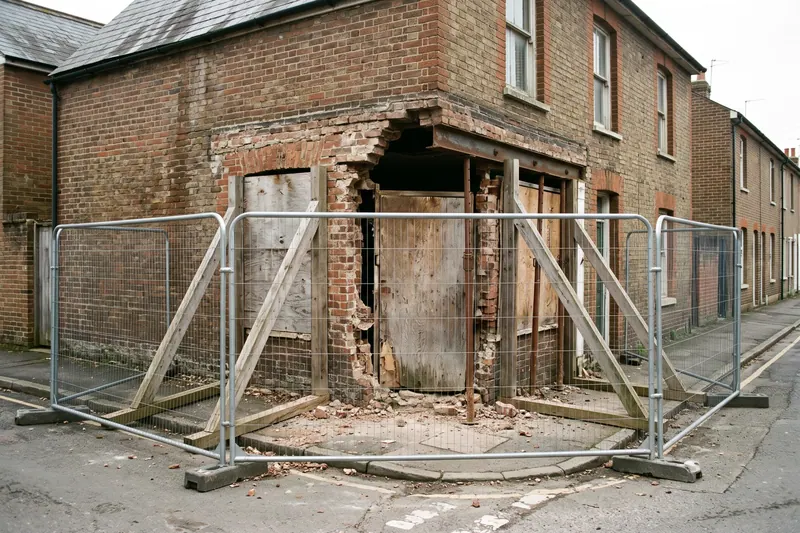
That's where we come in, booked by the owner or their agent. We close off the area with solid hoarding set back to the line the engineer gives us, board every opening so nobody gets inside, and fit props and shores exactly where the engineer's sketch puts them. We answer the phone 24 hours a day, 7 days a week, and we'll tell you honestly when we can get there and whether it's safe to work at night.
What powers do councils have over dangerous buildings?
Under the Building Act 1984, a council that thinks a building is dangerous can go to court for an order making the owner repair or demolish it. If the danger is immediate, it can act straight away and send the owner the bill. Either way, the owner usually ends up paying, so it pays to act first.
| Rule | What it means for you | Source |
|---|---|---|
| If a council considers a building or structure dangerous, because of its condition or the loads on it, it can apply for an order requiring the owner to carry out the work needed or, if the owner chooses, to demolish the dangerous part. | A council letter is the start of a legal process, not a suggestion. | Building Act 1984, section 77 |
| If the owner doesn't comply with the order in time, the council can carry out the work itself and recover its reasonable expenses, and the owner can be fined. | Doing nothing doesn't save money. It moves the decisions to someone else. | Building Act 1984, section 77(2) |
| Where a council thinks immediate action is needed to remove the danger, it can take the steps necessary, telling the owner and occupier first where that's reasonably practicable. | You may find the council's own fencing already up when you arrive. | Building Act 1984, section 78 |
| The council can recover its reasonable expenses for emergency measures from the owner, but not the cost of fencing off or watching the building after the danger has gone. | Fencing and watching costs run until the danger is dealt with, so a quick, proper repair or demolition limits the bill. | Building Act 1984, section 78(3) and (4) |
| The dangerous building powers are subject to the separate rules for listed buildings and buildings in conservation areas. | On a listed building, demolishing part of it isn't a simple choice. The engineer and the council plan round the consents. | Building Act 1984, section 77(3) |
| Planned demolition needs notice to the council under section 80 of the Building Act 1984. Crawley asks for at least six weeks. | If the engineer says it has to come down, build the notice period into the time the hoarding stays up. | Crawley Borough Council: demolition notices and dangerous structures |
Who signs it off
- 999, if anything is falling or about to fall onto people.
- The council's building control team, to report the structure.
- A structural engineer, to decide what's needed and where.
- Us, for the hoarding, boarding and propping they ask for.
Checked November 2026 against the Building Act 1984 on legislation.gov.uk, Crawley Borough Council and Mid Sussex District Council
What making it safe involves
Our part is the temporary works that keep people out of harm's way. The engineer's part is deciding what those works need to be.
Exclusion hoarding
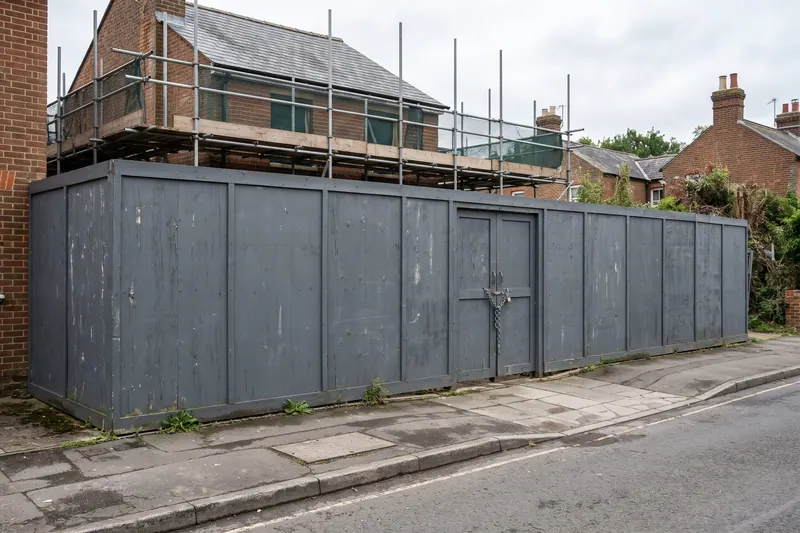
18mm ply on posts and rails, or ballasted braced frames where we can't dig, set back to the line the engineer gives for anything that might fall.
Boarding every opening
Doors and ground floor windows closed with ply on battens and security screws, so children and rough sleepers can't get into a building that could collapse on them.
Props and shores
Adjustable steel props on timber sole plates with spreaders at the head, and timber raking shores, placed and loaded exactly as the engineer's layout shows.
A lockable way in
A gate or door in the hoarding with a hasp and padlock, so the engineer, building control and whoever repairs or demolishes it can get in.
Checks after bad weather
We can come back after a storm to check the props are still tight, the boards are on and the hoarding hasn't been pushed in.
From the first report to repair or demolition
Reported and inspected
Building control
Someone reports the structure, a building control surveyor inspects it and contacts the owner about what has to happen.
Engineer's assessment
Your engineer
A structural engineer decides how far back people must be kept, what needs propping and whether the building can be saved.
Hoarding and boarding
Our team
The area closed off to the engineer's line and every opening boarded, with photos taken before anything is touched.
Props to the layout
Our team
Props, sole plates and shores fitted where the engineer has drawn them, and nowhere else.
Checked and agreed
Building control
The surveyor checks the measures are enough for now. The danger is contained, but not yet removed.
Repair or demolition
You
You decide the permanent answer with the engineer and the council. The hoarding stays until the danger has gone.
What to tell us when you call
- The address, and what has happened to the building
- Whether building control has been out, and any letter or notice they've given you
- Your engineer's name and any sketch or report, if you have one yet
- Whether the structure is next to a pavement, road or neighbour's garden
- Whether anyone lives in or uses the building or the ones either side
- Photos taken from a safe distance, never from underneath
- Whether it's listed or in a conservation area
- Where we can park the van and unload sheets
Props go where the engineer says, not where they look right
A prop pushing in the wrong place can do more harm than no prop at all. It can lift a lintel, punch through a floor or load a wall that was only just standing. So we don't prop by eye. The engineer gives us a layout, and we build it: steel props on timber sole plates so the foot can't sink, spreaders across the head so the load goes into the masonry evenly, and raking shores set at the angle on the drawing.
Then we tighten them, photograph them and leave them alone. Changing them is the engineer's call too.

What gets done wrong round dangerous buildings
Most of these come from wanting the problem to look handled before anyone qualified has seen it.
- The shortcut
Propping a wall by eye because it seems to be leaning
What we do insteadProps placed and loaded to the engineer's layout, and not before
- The shortcut
A prop foot on soft ground or a cracked paving slab
What we do insteadTimber sole plates on firm ground, with spreaders at the head
- The shortcut
Tape and a few cones round a bulging wall
What we do insteadSolid hoarding set back to the engineer's exclusion line
- The shortcut
Hoarding across the footway with nowhere for people to walk
What we do insteadA highway licence and a safe route for pedestrians agreed with the county council
- The shortcut
Boarding the front and leaving the back of a derelict building open
What we do insteadEvery opening closed, because whoever gets in is standing under the danger
- The shortcut
Pulling loose brickwork down by hand to save a visit
What we do insteadRemoval and demolition left to the engineer's plan and the right contractor
Had a dangerous structure letter from the council, or found a wall moving? Call us any time and we'll tell you honestly when we can get there.
Get a quoteQuestions owners ask about dangerous structures
Something else? Call or WhatsApp 07494 000065.
Who pays for making a dangerous structure safe?
Usually the owner. Under sections 77 and 78 of the Building Act 1984, a council that does the work itself can recover its reasonable expenses from the owner. If you book the hoarding and propping yourself, you pay us directly, and you get photos and an itemised invoice. Making safe is often covered by buildings insurance, but check your policy.
Can you tell me whether my wall is safe?
No, and you should be wary of anyone who isn't an engineer telling you it is. We can see that a wall is cracked or leaning, but whether it's moving, what it's carrying and what will hold it are an engineer's questions. We work with a structural engineer before propping anything structural.
The council has already fenced it off. Can you replace their fencing with hoarding?
Often, yes. Speak to building control first. They'll want to agree what replaces their fencing, and the exclusion line, before anything of theirs comes down. We then build the hoarding before their fencing is removed, so the area is never open.
How long will the hoarding need to stay up?
Until the danger has actually gone, which means the building has been repaired or the dangerous part demolished. That can be weeks or many months, especially where demolition needs six weeks' notice or a listed building needs consent. For long jobs we seal and paint the ply and check it after storms.
My neighbour's building looks dangerous. What can I do?
Report it to your council's building control team, with photos taken from a safe distance. If anything is about to fall onto people, call 999. The council can then use its powers against the owner. We can only put up hoarding on land where the owner, or the council, has asked us to.
Do you demolish dangerous buildings?
Demolition isn't part of this work. If the engineer says the building or part of it has to come down, that's a job for a demolition contractor working to the engineer's plan. Our hoarding and propping keep the area safe until then, and can be altered to suit when the demolition starts.
Other work around damaged buildings


Got a building that needs closing off?
Send us the address, what's happened and anything building control or your engineer has given you. We'll tell you honestly when we can get there, then put up the hoarding, boarding and propping they ask for, with photos and an itemised invoice.
Useful to send
- The address and what has happened
- Any council letter or engineer's sketch
- Photos taken from a safe distance