

Why the frame matters more than the boards
Every failed deck we're called to replace failed because the joists or supports weren't specced right. Not once has it been the boards. So before composite against timber, it's worth knowing what goes underneath, because it's the same question whichever board you pick.
The frame is the joists, bearers and posts. The Timber Decking and Cladding Association has recommended since January 2020 that deck joists and anything else giving exterior structural support are treated to Use Class 4, whether they touch the ground or not. Its reasoning is simple: wood starts to decay once its moisture content stays above 22%, and a joist under boards can stay damp for months without ever touching soil.
Then there's how long that treatment is meant to last. Treated timber for a deck frame is normally specified for a 15 year service life unless a longer one is asked for. Put a board with a 25 year warranty on a frame treated for 15 and the boards can outlive what's holding them up.
Colour proves nothing, either. Green or brown treated timber can look identical whatever it was treated to. Ask for Use Class 4 in writing and check it's on the delivery note. Our decking installation page sets out how we build the frame on every deck.

What goes into a frame that lasts
A deck frame doesn't need to be clever. It needs to stay dry, stay still and be built to the board maker's numbers.
- Footings to firm ground. Ground screws or pads, with the timber kept clear of the soil. Posts concreted straight into clay hold water against the wood.
- Joist tape on every top. A strip of tape along each joist stops water sitting in the screw holes and soaking into the timber where you'll never see it.
- Joist centres from the board maker's table. Every board has its own maximum joist spacing, and it gets closer on steps and diagonal layouts.
- Cut ends treated again. Factory treatment doesn't reach the middle of the timber, so every fresh cut gets a brush-on end-grain preservative.
- Clear of the house. Boards below the damp proof course, air bricks left open and a small gap behind the wall plate.
On a sloping garden in Surrey in April 2026 we framed a multi-level deck on ground screws, with C24 joists on hangers and black tape along every joist. The full write-up of that deck shows the frame before a single board went down.
Why we tape the joists
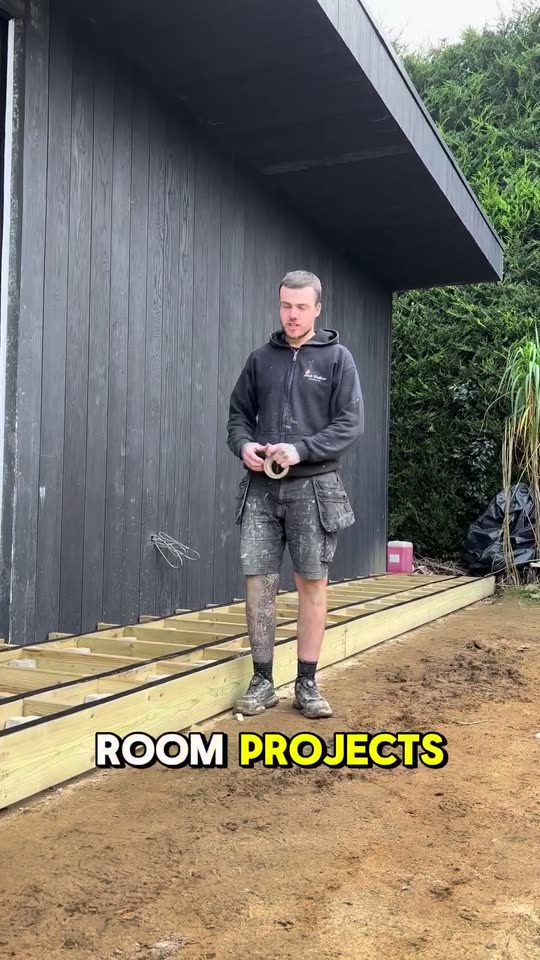
Thirty seconds on the cheapest part of a deck that does the most to keep the frame dry.
Timber, composite and mineral boards compared
Three families of board, not two. Millboard gets its own column because it isn't a wood composite at all.
| What matters | Timber (softwood or hardwood) | Wood-plastic composite | Mineral resin (Millboard) |
|---|---|---|---|
| What it is | Real wood. Softwood boards are pressure treated, hardwoods rely on their own heartwood | Wood fibre or flour mixed with plastic. Better boards have a polymer cap over the core | Polymer resin with mineral filler and fibre reinforcement, no wood |
| Upkeep | Clean, then oil or stain every year or two to keep the colour | A wash in spring and autumn | A wash in spring and autumn |
| In full sun | Warm underfoot, and dries and checks if left unoiled | Can get hot, darker colours most | Darker colours get hotter, so pick lighter shades for a south-facing deck |
| When it's worn | Sand back and re-oil | Scratches show and can't be sanded out. Damaged boards get replaced | Damaged boards get replaced |
| Fixings | A4 stainless screws, pre-drilled in hardwood | The board maker's screws or clips | Durafix screws, which the warranty requires |
| Warranty | No board warranty as such. Life depends on species, treatment and detailing | Varies by maker and range, so read the conditions | 25 years for homes, if registered within 90 days |
| Frame underneath | Use Class 4 timber | Use Class 4 timber, or the maker's own subframe | Use Class 4 timber, or the maker's own subframe |
Upkeep and warranty terms come from the board makers and change with each range. Check the current warranty for the exact board you're buying before you order.
Timber boards: softwood, hardwood and modified wood
Treated softwood is the cheapest deck you can build well. The boards are pressure treated pine for use above ground, and they feel like a deck should: warm, a bit of give, a smell of timber after rain. The trade-off is upkeep. Leave it a few years unoiled and it greys, checks along the grain and can lift splinters. In a shaded Sussex garden it also greens up and gets slippery, so a scrub each spring matters more than the oil.
Hardwood is denser and harder, so it shrugs off dents and scuffs better than softwood. Its durability comes from the heartwood, so ask for sapwood-free boards and for FSC or PEFC certified timber. Hardwood needs every fixing pre-drilled and stainless screws, and you can either oil it to hold the colour or let it weather to silver.
Modified timber, thermally treated or acetylated, is sold as more stable and longer lasting than ordinary softwood. Check the durability class the maker gives for the exact product, and pre-drill near the ends of thermally modified boards, which are more brittle.
Whichever you pick, timber can be sanded back. That's the thing composite can't offer.
Wood-plastic composite: capped and uncapped
Most boards sold as composite are wood-plastic composite: wood fibre or flour mixed with plastic and pushed out through a die. They don't rot, splinter or need oiling, which is why people buy them.
Quality varies more than the brochures let on. Uncapped boards take on water at the surface, stain, fade and can grow mould, and the hollow ones can sag between joists and sound tinny underfoot. Capped boards have a polymer shell over the core and resist staining and fading far better. If you're going composite, capped is the one to buy.
Two downsides stay with any plastic-based board. It gets hot in full sun, especially in dark colours, and a deep scratch is there for good. Composite also moves with temperature, so the end gaps and joist centres have to come from the maker's guide, not from habit. Get those wrong and boards bow or open up at the joints.
Warranties on the better capped ranges are long, but they're conditional. Most depend on the maker's fixings and installation guide, so read the terms before you sign a quote that uses different screws.
Mineral resin boards, and why Millboard isn't a wood composite
Millboard is the board that turns up most on our Instagram, on decks and on cladding, and it's often lumped in with composites. It isn't one. Millboard describes its boards as recycled minerals, polymer resin and fibre reinforcement, entirely wood-free, moulded from real timber so the grain looks like real wood rather than a printed pattern.
No wood means nothing to swell or rot in the board itself. The grip on wet days is good, and there's a range made for extra grip. The residential decking warranty is 25 years, but only if you register within 90 days of buying and the boards are fixed with Millboard's own Durafix screws. Whoever fits it should use them, and remind you to register.
A few points from Millboard's own guidance are worth knowing before you plan a barbecue corner. Keep heat sources about a metre from the boards, stand a fire bowl on a slab rather than on the deck, and expect darker colours to run hotter in sun. Millboard also rules its decking out for balconies and roof terraces on buildings over 11 metres.
To see the material up close, look at the 1970s house reclad in Millboard boards, where oak-effect boards replaced the old tile hanging as part of a wider job we worked on.
Does the board you choose change the planning rules?
No. Planning looks at height, position and how much of the garden is covered, not at what the deck is made of. Most garden decks don't need permission as long as no part is more than 300mm above the ground, it isn't in front of the house and it doesn't push additions past half the garden.
| Rule | What it means for you | Source |
|---|---|---|
| Decking more than 300mm above the ground at any point counts as a raised platform and needs planning permission. | On a sloping garden, part of a deck can cross that line. Measure at the lowest corner, not at the back door. | GPDO 2015, Schedule 2 Part 1, Class E |
| Decking under 300mm still counts towards the half-of-the-garden limit and can't sit forward of the front of the house. | A deck plus a garden room and a shed can tip a small garden over. Front garden decks need permission. | Planning Portal: decking |
| On designated land such as a conservation area, no decking either side of the house. In a National Landscape, decking more than 20 metres from the house is capped at 10 square metres. | This matters on the edges of the High Weald and the Surrey Hills, and in older town centres. | Planning Portal: decking |
| Flats, maisonettes and the grounds of listed buildings have no permitted development rights for decking. | You'll need permission whatever the height or the board. | Planning Portal: decking |
Checked November 2026 against the GPDO 2015 and the Planning Portal
Does decking need planning permission?
Quick tool: Check whether your deck needs planning permission
Which we'd pick, garden by garden
There's no single right board. This is what we'd say if you asked us standing in your garden.
- Shaded, under trees, north-facing. Capped composite or mineral resin. Timber in deep shade greens up and gets slippery, and you'll be scrubbing it every spring.
- Full sun, children in bare feet. A lighter colour in any material. Dark composite on a south-facing deck in July is hot to stand on.
- Tight budget, or a deck you'll change in ten years. Treated softwood boards on a properly treated frame. Cheap boards on a good frame is a sensible deck. Expensive boards on a cheap frame isn't.
- Period house or a cottage garden. Hardwood or a good softwood, left to weather if you like silver timber.
- Barbecue, fire bowl or outdoor kitchen on the deck. Plan a slab or a non-combustible area for the heat, whatever the boards.
And if you can't decide, decide the frame first. A good frame takes any of these boards, and the boards can be replaced one day without touching what's underneath.
What this means if you're planning a deck
Pick the board on looks, upkeep and how the garden gets the sun. Then make sure the quote names the frame: the joist timber and its use class, the footings, the joist centres and the fixings. If a quote only describes the boards, ask what's underneath before you sign.
We build composite, mineral resin and timber decks across Crawley, Sussex and Surrey. Send us a few photos from the back door and the far end of the garden, and tell us roughly how much the ground falls. Our decking page covers how we build, and the area calculator gives you a rough board quantity before you talk to anyone. If the garden slopes, read our raised decking page too.


Sources
- Planning Portal: Decking, planning permission
- legislation.gov.uk: Town and Country Planning (General Permitted Development) (England) Order 2015, Schedule 2 Part 1
- Timber Decking and Cladding Association: Decking timber options
- Wood Protection Association: Make sure it's 4
- Millboard: What Millboard decking is made of
- Millboard: Warranties
- Millboard: Fire and safety questions