What does a carpenter do?
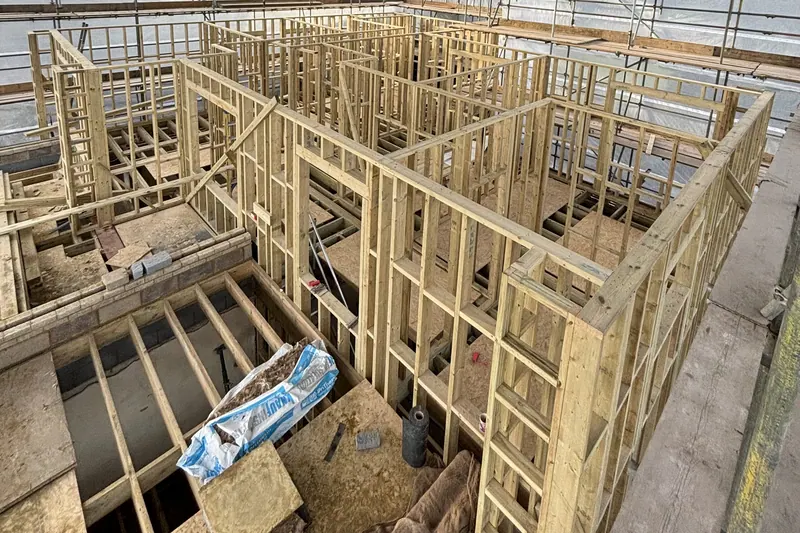
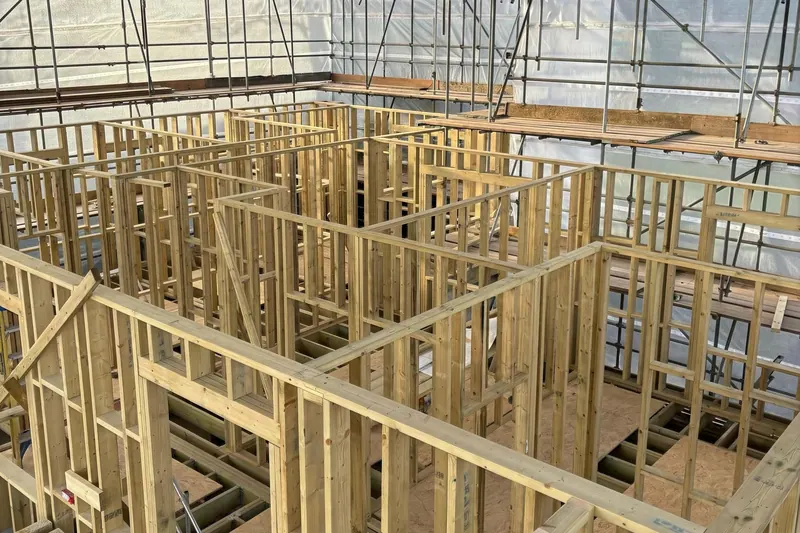
A carpenter works in the building, fixing timber where it's going to stay. The trade splits that work into two stages either side of the plasterer.
First fix is the structure and the bones: stud walls, floor joists, roof rafters and purlins, noggins for radiators and TV brackets, and the door linings that doors will later hang in. Second fix comes after plaster: hanging the doors, skirting and architrave, stair balustrades, boxing in pipes, loft hatches and built-in units. Our first fix and second fix guide goes through that order stage by stage.
Roof work is carpentry too, and it's where a lot of the skill sits. Nobody makes a hip-end roof with a flying valley at a bench. It gets set out, cut and pitched on site, rafter by rafter.
So when people ask us for a carpenter, they usually mean the person who turns up with the timber and leaves it fixed, square and finished. That's most of what we do on our carpentry and joinery jobs across Sussex and Surrey.
What does a joiner do?
A joiner makes things out of timber, traditionally in a workshop, and hands them over ready to fit. Staircases, doors and their frames, sash and casement windows, panelling, mouldings and fitted furniture are all classic joinery.
The work is done to a drawing or a cutting list, on machines a van can't carry: a planer thicknesser, a spindle moulder, a mortiser, a wide-belt sander. That's why joinery can hold tighter tolerances than site work. The timber sits flat on a bench, the light is good and nothing is fighting a wall that leans.
The catch is that a workshop piece has to fit a room it was made away from. A perfectly made staircase is only as good as the person who measured the opening and the person who fits it. Plenty of joiners fit their own work for exactly that reason.
The word itself is regional as much as anything. Further north and in Scotland people say joiner for the whole trade. Round here most people type carpenter, whatever the job.
Carpenter and joiner side by side
The textbook split, which still holds for training even though most people on a house job do a bit of both.
| What you're comparing | Carpenter | Joiner |
|---|---|---|
| Where the work happens | On site, in the building | At a bench, usually in a workshop |
| Typical jobs | Roofs, stud walls, joists, door linings, hanging doors, skirting, architrave, kitchens | Stairs, doors and frames, windows, panelling, mouldings, fitted furniture |
| Works to | The room as it is, out of square walls included | A drawing or cutting list, to tight sizes |
| Main tools | Saws, routers, levels and lasers that travel in a van | Fixed machines such as a spindle moulder and planer thicknesser |
| Apprenticeship option | Site carpenter | Architectural joiner |
| What you see of it | Mostly hidden once the plaster and boards go on | Almost all of it, every day |
The Level 2 carpentry and joinery apprenticeship in England is one standard with two options, site carpenter and architectural joiner. That split is the clearest official line between the two trades.
Where carpentry and joinery overlap on a real job
On a house job the line blurs, because good portable tools let a carpenter do a lot of bench work in the next room. Three of our own jobs show how.
The window seat at the top of this page was joinery done on site. The bay has five faces and none of them is quite the same, so the seat was made up as panels and lids, then scribed into the bay so it follows every face. A flat-pack unit would have needed a filler strip on each one.
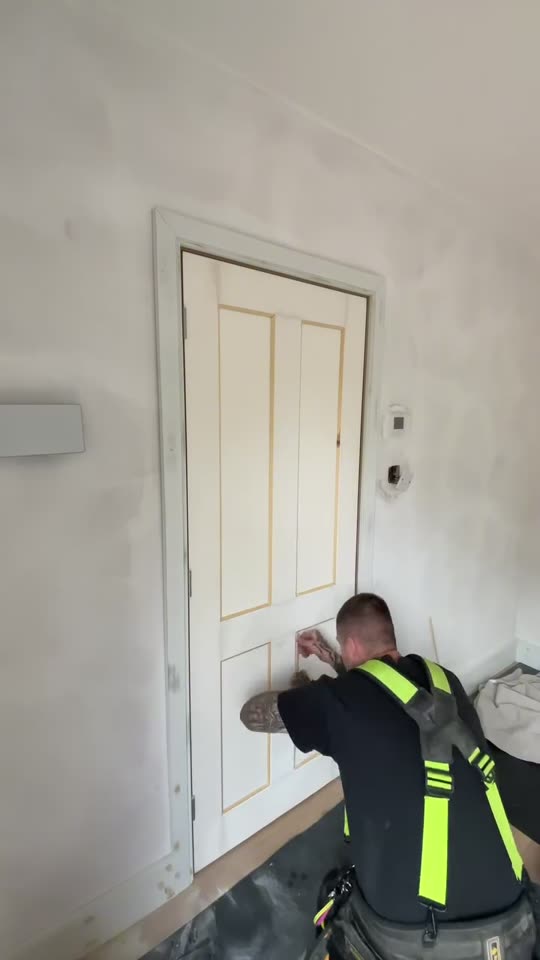
In July 2024 we filmed a run of plain flat doors being turned into four-panel doors, with beads cut on a mitre saw and pinned on, so the new doors matched the old ones in the rest of the house. And in November 2025 we needed skirting to match a profile nobody sells any more. The boards were ripped from MDF sheet on a guide rail and the moulding run with a router, on site.
None of that needs a full workshop. It needs someone who can make a part and fit it in the same visit.

Watch flat doors turned into panelled doors
Joinery doesn't always mean a workshop. This one was done in an old brick outbuilding next to the house.
Carpenter, builder or handyman?
These get mixed up as often as carpenter and joiner, and the difference matters more for what you're paying for.
A builder runs the whole job: the groundwork, the brickwork, the other trades and the paperwork. Most extensions, loft conversions and structural alterations need Building Regulations approval, even when they don't need planning permission. And since October 2023 the law requires everyone designing or building your project to be competent for the work they take on, and to make sure it complies.
A handyman covers small mixed jobs in one visit: a shelf, a curtain pole, flat-pack furniture, a dripping tap. That's useful work. But anything structural, anything with a staircase in it, or anything that has to stay straight over a long run is carpentry, and it shows when it isn't done by a carpenter.
We sit between the two. We're carpenters who build, so on an extension or a loft conversion the timber, the roof and the finish are ours, and we bring in the other trades. Our building work page covers how those jobs run.
Which one do you need for your job?
A quick guide by job. Where it says carpenter, that's site work. Where it says joiner, someone needs a bench for it.
- New internal doors in old frames: a carpenter. The doors are bought in and the skill is in the hanging.
- A run of skirting and architrave: a carpenter, unless the profile has to be made to match.
- A kitchen fit: a carpenter. The units arrive made, and the work is levelling, scribing and fitting.
- Fitted wardrobes or alcove units: either. Often made on site to suit walls that aren't square.
- A new staircase made to measure: a joiner makes it, a carpenter fits it, sometimes the same person.
- Replacement sash windows: a joiner, plus whoever fits them into the old box frames.
- A roof, stud walls or new floor joists: a carpenter, every time.
- A matching period door or moulding: a joiner, or a carpenter with the tools to run one.
What to ask before you book a carpenter or a joiner
The job title tells you less than you'd think. These questions tell you more.
- Have you done a job like mine, and can I see it? Photos of finished work, and ideally the work before it was covered up.
- Who makes it and who fits it? If a piece is coming from a workshop, ask who measures for it and who is on site when it goes in.
- Will anything be made to measure? Made items take longer than stock ones, so the quote should say how long and who orders them.
- What's in the quote and what isn't? Materials, waste, decoration, other trades. Our guide to how we quote shows what a written quote should list.
If you're comparing firms, our guide on checking a builder before you hire covers company details, references and paperwork. Trade words you meet along the way, from noggin to scribe, are in our glossary.
How we split the carpentry and joinery on a house job
On most jobs we're both. The roof, the walls and the floors are carpentry, and we do them. The pieces you see every day, a window seat, a run of fitted shelves or a skirting nobody makes any more, we make ourselves, on site where we can. If a job really needs a workshop, a hand-made oak staircase for instance, we'll say so at the survey and tell you how we'd handle it.
You don't need to know which word fits before you call. Send us a few photos and a line about what you're after. We'll tell you whether it's ours. Our carpentry and joinery page has more of our work, and there's detail on skirting and architrave and kitchen fitting too.
Read next